TURNING MILLPROCESS STUDIO
Simply refining what goes into a company, so what comes out is quality, recognition, and reputation.
Capture · Optimize · Implement · Embed
A direct, plain-text evaluation within one business day. No automated sales sequence.
WHAT I DO
Here is the plain version, before we get to what it costs to keep doing nothing.
Four ways to work together — Capture what is coming in, Optimize what you already have, Implement and manage the new flow, then Embed to improve how the operation itself runs. They flow naturally from one to the next, yet each stands on its own. You start wherever your business is today.
- Capture
Automated Lead Intake & Response
Capture and organize incoming calls, missed calls, texts, emails, and website inquiries — automating the first response and routing each request to the right person or system, so nothing waits in a voicemail or an inbox and quietly disappears.
- Optimize
Getting Found, and Knowing What Works
Your customers are already searching. The real questions are whether they find you when they do — and whether you can tell what is actually bringing the work in. This sharpens how the business shows up where people look, and puts honest measurement behind it, so you stop guessing which efforts pay off. The practical pieces — your Google listing, local search, and analytics — are handled for you, not handed to you.
- Implement
Putting the Systems to Work
New systems only matter once they run in the real world. This is the hands-on stretch after the build — putting the new intake and optimized flow into daily operation, managing the call routing, watching the work that starts coming in, adjusting what needs adjusting, and reading the results together before deciding whether to go deeper.
- Embed
Practical Operational Architecture
When it is time to work on the operation itself, this is a focused 120-day remote engagement for owners who need someone working alongside them — not another report sitting on a desk. Operating as your remote Operations Manager, we locate the operational pressure, prioritize it, make practical decisions together, and put real improvements into operation.
I operate as a fully capable Operations Manager at a fraction of the cost, helping you build an operation that can handle continued growth and expansion.
Building a company that relies on its systems, not you.
THE HIDDEN WEIGHT
You built something real. It is working. But underneath the daily grind, there is a weight.
And the heaviest part of it is never financial.
It may be your time. Your health. Your evenings. The family dinner interrupted by another call or message. The game you missed while bidding a project from the cab of your truck. The stress of always having one more problem to solve.
Your company may be producing revenue while quietly charging you in every other currency.
If we can locate the weight, we can build a process to lift it.
Realize the growth will come, but you need systems to capture what is already yours. Working, proven processes allow your operation to shine and operate efficiently and effectively, day and night, season to season.
Without these processes, growth only exposes the next weakest link in the operation.
Good people drowning in bad systems, skilled crews missing daily opportunities, and endless loops of phone tag all create the same problem:
Losing business that is already knocking at your door is the heaviest loss of all.
THE PRESSURE PATTERN
A working business is not always a healthy business.
Growth does not automatically make a company healthier. Sometimes it simply makes the existing weaknesses harder to ignore.
The pressure looks different from one business to the next.
These are examples, not limits — the same pattern shows up in almost any business where the work starts moving faster than the systems behind it.
- An HVAC company may lose an emergency call while every technician is already in the field.
- A landscaping operator may have bids waiting but no clear view of crew capacity, routing, or follow-up.
- A restoration company may be responding to urgent calls while critical information is scattered across texts, voicemails, and field notes.
- A plumbing contractor may be answering customer requests between jobs.
- A dental practice may be balancing appointments, cancellations, recalls, insurance questions, and an overwhelmed front desk.
- A law office may have qualified inquiries waiting for review while the attorneys capable of evaluating them are buried in active matters.
The trade changes. The pressure pattern is often familiar:
Information arrives. Responsibility is unclear. Follow-up depends on memory. The owner or a small number of key people quietly carry the entire weight of the system.
The most expensive work you lose is often the work that was already trying to reach you.
THE CONSULTANT REALITY
Every owner is already consulting someone.
The contractor beside you at the game. The mentor you call after dinner.
The peer who already made the mistake you are weighing.
The breakfast group. The networking table. The association meeting.
We call it networking. Most of the time it is something quieter—looking for someone who carries the same weight, who recognizes the problem, who makes the load feel a little less lonely.
That need is real. Ownership is isolating, and the search for someone who simply gets it is one of the most human parts of the job.
But recognition is not resolution. Sharing the weight feels good on Thursday. It rarely changes the operation on Monday.
A real consultant does more than listen—someone outside the daily pressure, who can see the operation clearly without being trapped in the same habits, history, and emergencies you are.
And there is a particular value in someone who is not in your space. Not riding along in the truck. Not hovering in the office. Not one more person to manage. A focused, remote partner stays fixed on one weakness at a time—one pressure point—for a defined 120 days, with a destination you can measure and verify.
When you live inside the business every day, friction rarely presents itself as one obvious problem.
It looks like constant interruptions, manual workarounds, missed calls, delayed invoicing, exhausted staff, and another evening spent fixing something that should have had a reliable process long ago.
Turning Mill helps bring that scattered weight into focus.
Once the friction is visible, it can be measured. Once it is measured, it can be redesigned.
The goal is not to replace good people with software. The goal is to stop asking good people to compensate for systems that were never built.
Let systems carry the repetition, so people can carry the responsibility.
WHAT OPERATIONAL ARCHITECTURE MEANS
A collaborative journey, not a sell-and-run product.
Operational Architecture is the ongoing practice of understanding how work enters, moves through, and leaves a company—and then improving that movement with the people, processes, and tools already available.
It is hands-on. It is collaborative. It is measured in regular contact and practical changes, not in a static binder or strategy document handed off at the end.
This is a shared journey of collecting data, collaborating around real-world constraints, building working systems, and refining them together over time.
This is not a sell-and-run situation.
It is a collect, collaborate, build, grow, and share-together journey.
The working sequence is
When you engage Turning Mill, the work combines four operational functions:
Intake oversight
Designing and monitoring the first moments of client contact so inquiries are captured and organized instead of depending on memory.
Lead and opportunity management
Organizing routing, qualification, communication, and follow-up so valuable opportunities do not disappear into voicemail, texts, inboxes, or busy schedules.
Fractional operations support
Working directly with the owner and team to examine capacity, scheduling, handoffs, communication, and the bottlenecks that keep returning.
Practical metrics review
Looking at actual operating reality—where time is lost, where work slows down, where margins slip, and where the next pressure point is forming.
This is not a product that is installed and handed over.
It is not a single system that solves everything at once.
It is a focused 120-day engagement — a one-on-one working relationship with regular contact, generally weekly or every few days depending on the phase of work.
The work is to collect what is happening, collaborate around the constraints, build what is needed, watch what happens in practice, and improve the next important point of pressure together.
You are not being sold a thing and left with it. You are engaging someone to stay close to the operation, help make the right things repeat reliably, and reduce the amount of the business that depends on one person carrying it personally.
THE WORK
First
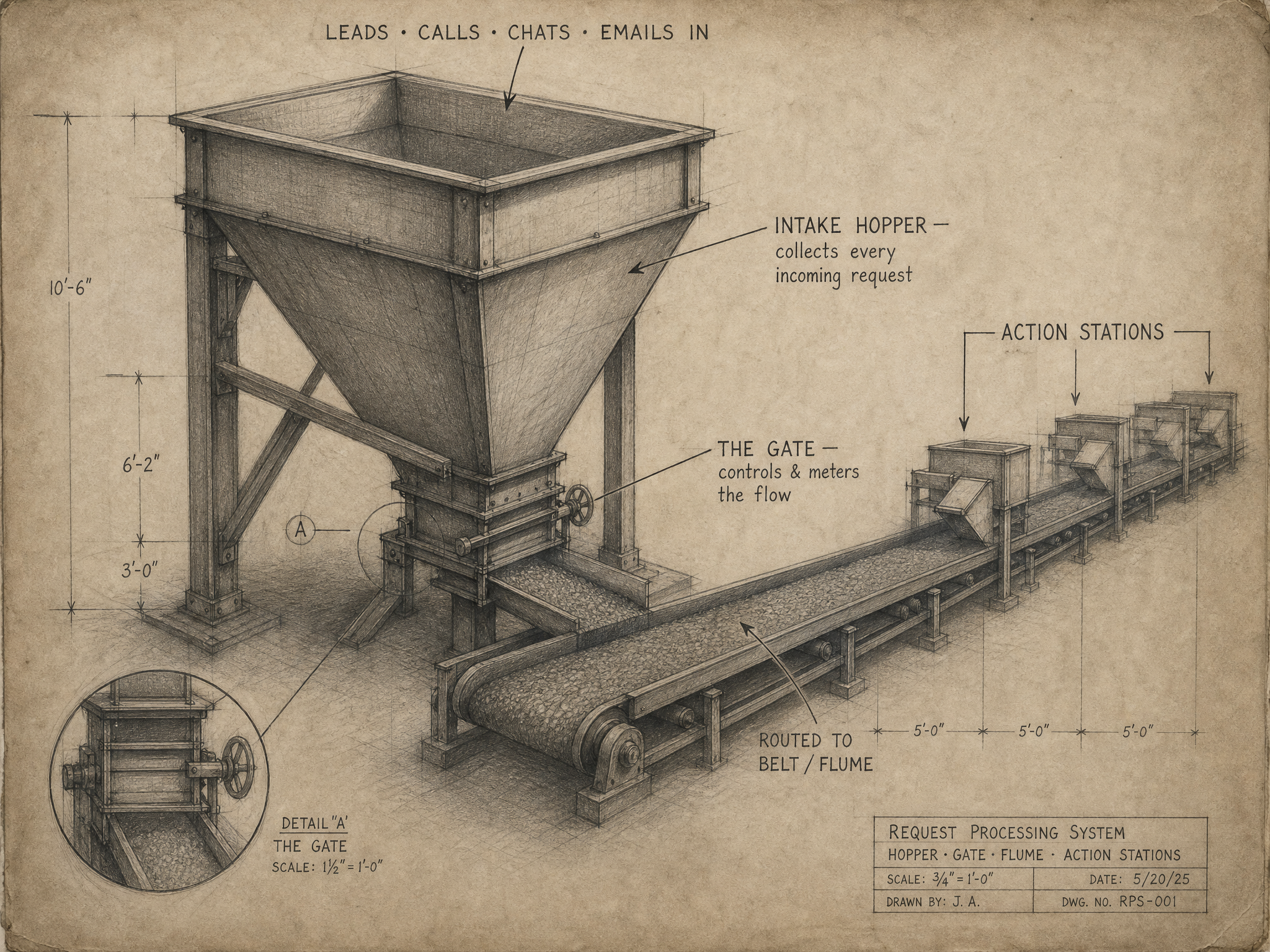
The Hopper & The Gate
Important inquiries should not disappear into voicemail, a busy phone, an inbox, a text thread, or someone's memory.
The Hopper & The Gate organizes the first moments of contact so the business can respond, collect the right information, route the request properly, and present itself as ready to receive the work.
Then
Turning Mill Operational Architecture
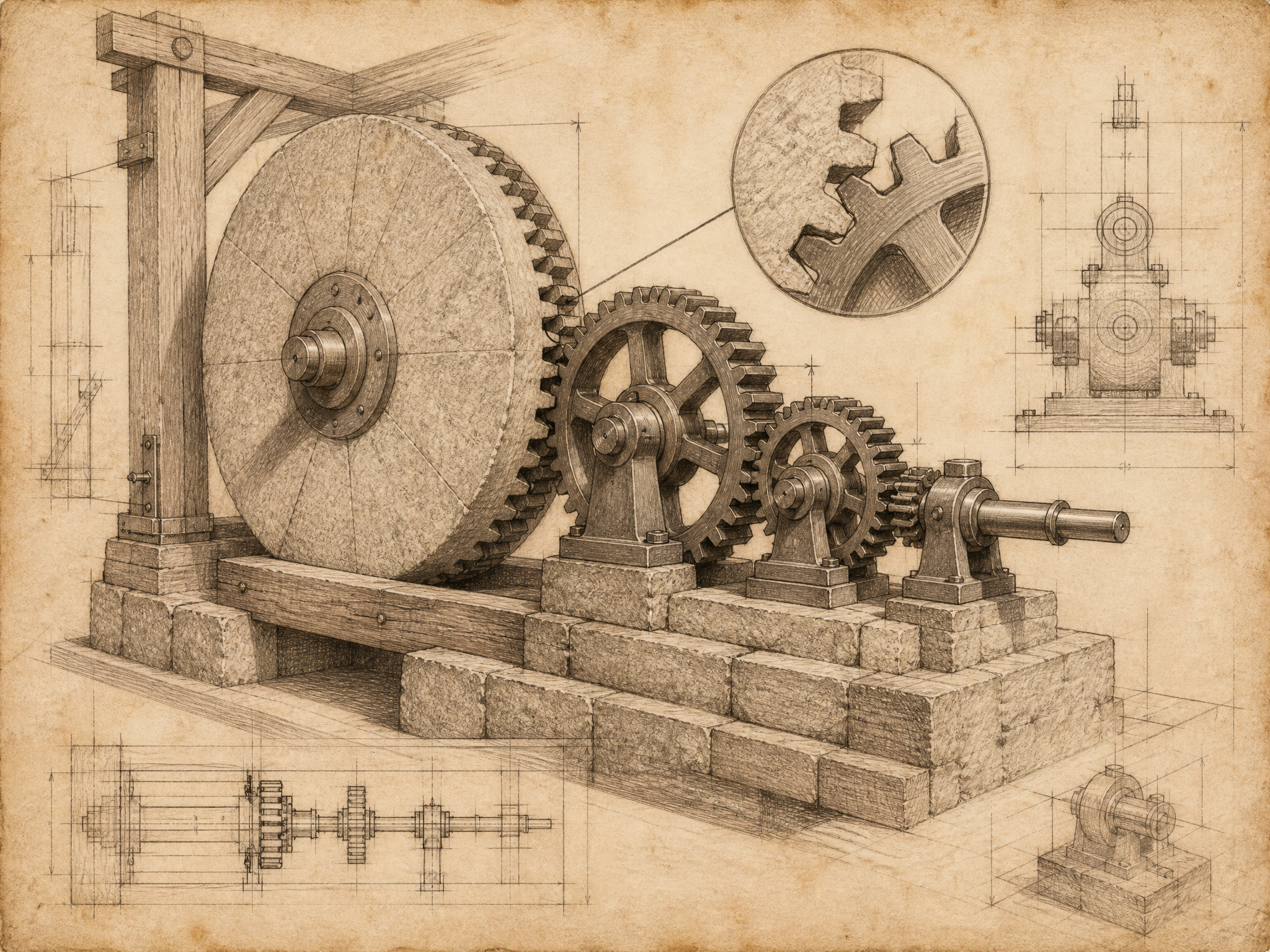
Capturing more work is only useful if the operation can deliver it well.
Operational Architecture works on the systems behind the first response: scheduling, capacity, labor, handoffs, routing, quoting, invoicing, collections, equipment, communication, and the decisions that determine whether growth strengthens the company or simply makes everyone busier.
THE WORKING RELATIONSHIP
Purpose-built remote architecture.
This work is conducted remotely by design.
Turning Mill works with clients through video check-ins, voice communication, screen sharing, direct access to relevant workflows, and documented digital communication.
The work does not depend on physical proximity. It depends on access, regular communication, clear observation, and consistent follow-through.
There are no rushed drive-by meetings or half-attention conversations between job sites.
Working this way also means working with focus—full attention on one workflow at a time, without the distraction of being another body on the job site or in the office.
Because the engagement is digital, processes, decisions, workflows, and handoffs can be documented clearly so important operating knowledge does not remain trapped in someone's head.
CAPACITY
Direct involvement requires real capacity limits.
Turning Mill is intentionally constrained by the number of companies Dustyn can personally review, architect, and support with full attention at any one time.
This is not an artificial marketing tactic. It is a practical limit on how many companies can receive genuine direct involvement.
Once active capacity is committed, qualified businesses enter the next scheduled window in the order they are received and reviewed.
Next scheduled review window opens as capacity clears
FOUNDER STORY
I learned this by getting it wrong first.
For more than three decades I operated companies—commercial landscape construction, heavy equipment dealerships, wholesale nursery operations, land development, and property renovation. At the peak I was managing more than sixty crew members across multi-million-dollar operations.
For most of that time, the whiteboard was my operational guru. If it made it to the board, it happened. If it did not, it lived in my head—and I was too busy doing the work to build anything better.
The realization came slowly: the opportunity I kept chasing outside the company was already sitting inside it. I turned my attention away from external marketing and toward the internal systems—workflow, efficiency, and metrics.
The results were not abstract. Relationships got stronger. The days got shorter and more manageable. Margins improved because the work, and the billing, became more accurate. The hard part was the transition itself—moving toward accountability and structured workflows instead of heroics.
But the operation slowly stopped depending on me for every answer. Supporting crews became departments. Departments became standalone businesses.
The most valuable companies are not dependent on one person remembering, fixing, answering, and deciding everything. They are supported by processes and systems that allow good people to do good work consistently.
THE STARTING POINT
Let's find where your operation is under pressure.
You do not need to have all the answers mapped out before you start.
Tell us how your business currently receives work, where communication slows down, how many people carry the operation, and what would break first if volume surged tomorrow.
Whether you run an HVAC company, landscaping operation, restoration business, plumbing company, dental practice, law office, or another service-based operation, the starting question is the same:
Where is valuable information, time, or responsibility getting stuck?
The goal is not to grade your business.
The goal is to locate the weight and build a clear path forward.